internet

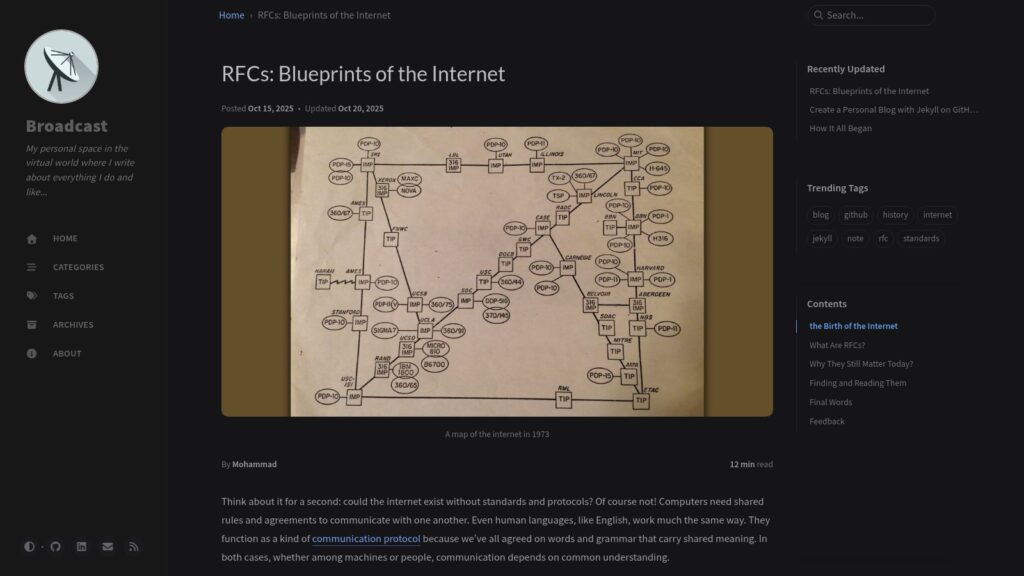
What Are RFCs? The Forgotten Blueprints of the Internet

RFCs (Requests for Comments) are documents that establish internet standards and communication protocols, vital for technology and IT professionals. Originating in 1969, they record development ideas and standards, helping ensure consistent operation across the network. Key to the internet’s history, early networking efforts, including ARPANET, laid the groundwork. RFCs explain protocols like TCP/IP and DNS, serving as essential references for reliable system design. Understanding RFC terminology is crucial for accurate implementation. The RFC Editor and IETF maintain and publish these documents, which are foundational for internet architecture and ongoing technological evolution.

https://ackreq.github.io/posts/what-are-rfcs/

What Are RFCs? The Forgotten Blueprints of the Internet Read More »

Your Review: Project Xanadu

Extreme TL;DR: “Project Xanadu,” envisioned by Vannevar Bush in 1945 as the “memex,” aimed to revolutionize knowledge sharing but remained unrealized due to lack of development. Doug Engelbart and Ted Nelson later pursued hypertext systems but faced challenges. Engelbart created groundbreaking tools (e.g., mouse, hypermedia) showcased in “The Mother of All Demos,” while Nelson’s Xanadu project, aiming for interconnected documents and copyright solutions, struggled with funding and technical feasibility, ultimately fading into obscurity.

https://www.astralcodexten.com/p/your-review-project-xanadu-the-internet

Your Review: Project Xanadu Read More »

My First Months in Cyberspace

In early 1995, Phil Gyford explored the internet at age 23, living in Bristol. After abandoning a career as an illustrator, he became enamored with technology and purchased a modem and an Apple Macintosh LC to connect to the burgeoning online world, which required significant effort to set up. Despite challenges, Gyford found joy in email, Usenet, and creating web pages, providing a platform for instant, global communication and self-expression that transformed his social connections and experiences.

https://www.gyford.com/phil/writing/2025/10/15/1995-internet/

My First Months in Cyberspace Read More »

A History of the Internet, Part 3: The Rise of the User

Extreme TL;DR: Internet’s evolution: ARPANET to World Wide Web; rise of user-generated content; Google revolutionizes search; MP3s lead to file-sharing, Napster’s legal troubles; dynamic web sparks blogs & Wikipedia; social media’s rise with MySpace and Facebook; mobile phones transform internet access; backlash against tech monopolies, misinformation, doomscrolling, enshittification, and AI’s threats to web quality.

https://arstechnica.com/gadgets/2025/09/a-history-of-the-internet-part-3-the-rise-of-the-user/

A History of the Internet, Part 3: The Rise of the User Read More »

Home

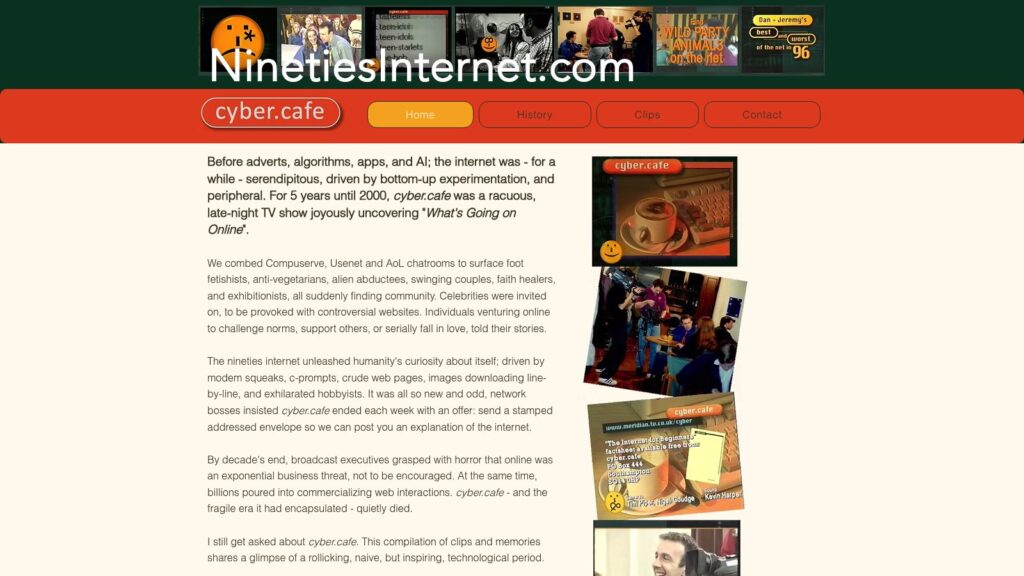
NinetiesInternet.com recalls the pre-commercial era of the internet, highlighting “cyber.cafe,” a late-night TV show from 1995 to 2000 showcasing diverse online communities. It celebrated curiosity and experimentation before commercialization took over, leading to the show’s end. The site shares clips and memories from this vibrant period of online exploration.

https://www.ninetiesinternet.com/

Home Read More »

Internet Infrastructure Map

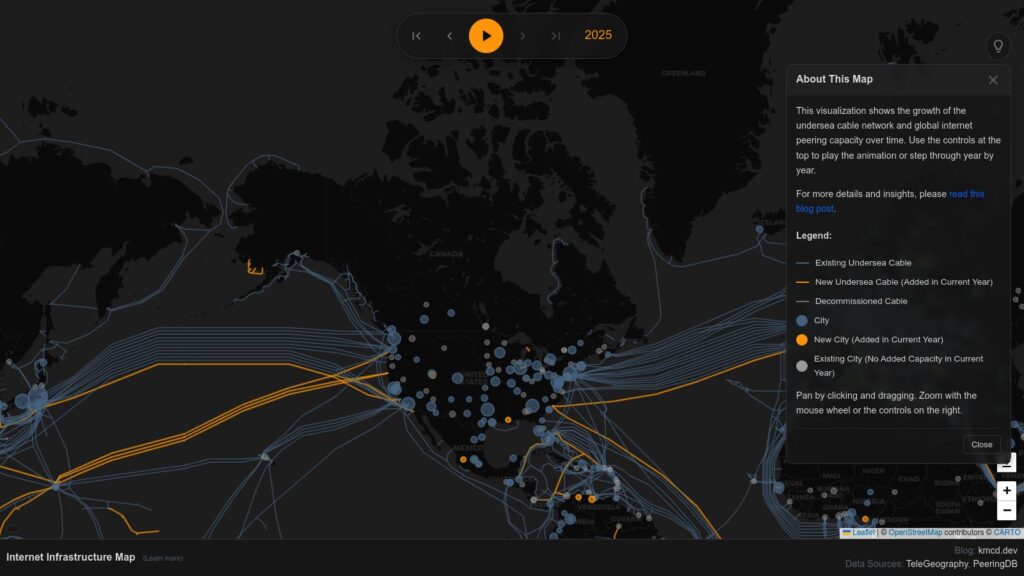
Internet Infrastructure Map shows growth of undersea cables and peering capacity over time. Users can animate or navigate year by year. As of 2025, there are 602 total cables, with 31 new ones spanning 144,320 km. Top cities by peering capacity include Amsterdam (200 Tbit) and Frankfurt (166 Tbit). Regional capacities: Europe 1.5 Pbit, Asia 430 Tbit, North America 403 Tbit. For more insights, visit the linked blog.

https://map.kmcd.dev/

Internet Infrastructure Map Read More »

WebAIM: History of the Browser User-agent String

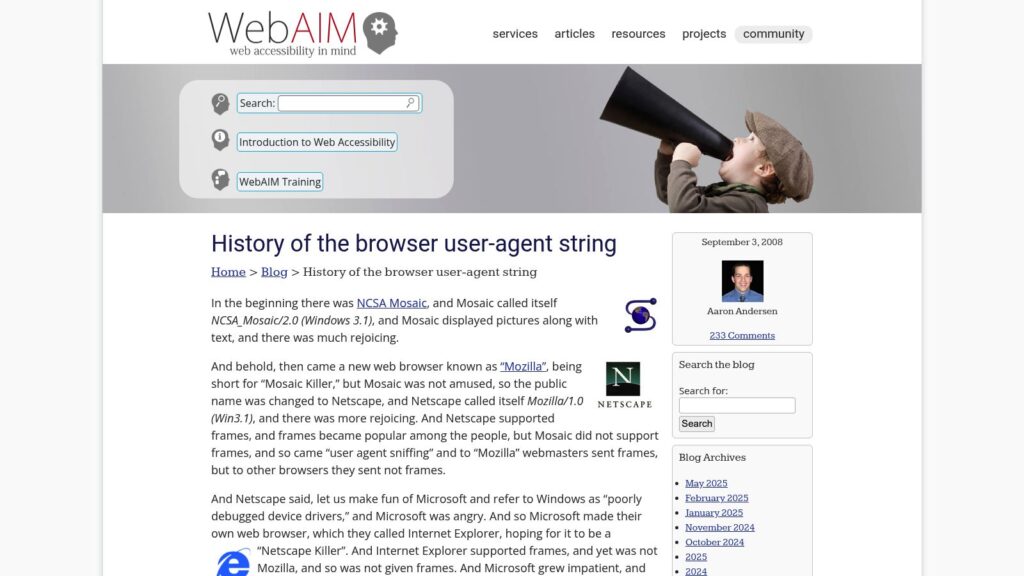
Browser user-agent strings evolved from early browsers like NCSA Mosaic to the competitive landscape involving Netscape, Internet Explorer, and others like Firefox and Chrome. This tangled history shows various browsers mimicking each other for compatibility, leading to a confusing mix of user-agent strings that often begin with “Mozilla,” rendering them largely ineffective for accurate browser identification.

https://webaim.org/blog/user-agent-string-history/

WebAIM: History of the Browser User-agent String Read More »

A History of the Internet, Part 2: The High-tech Gold Rush Begins

TLDR: The Internet’s evolution in the ’90s saw the rise of the World Wide Web, introducing browsers like Mosaic and Netscape, amid the dot-com boom. Innovations like hypertext, email, and graphical interfaces spurred rapid online growth. However, the bubble burst in the early 2000s, leading to significant market declines despite earlier exuberance. The next article will explore companies that emerged post-collapse.

https://arstechnica.com/gadgets/2025/06/a-history-of-the-internet-part-2-the-high-tech-gold-rush-begins/

A History of the Internet, Part 2: The High-tech Gold Rush Begins Read More »

An Ars Technica History of the Internet, Part 1

Extreme TLDR:
Internet’s inception began in 1966 due to Robert Taylor’s frustrations with multiple terminals at ARPA. Sparked by J.C.R. Licklider’s early vision of an “Intergalactic Computer Network,” Taylor proposed ARPANET to connect computers, eliminating inefficiencies. Key innovations included packet switching and the Interface Message Processors (IMPs) developed by Bolt Beranek and Newman. The ARPANET evolved, later adopting TCP/IP protocols, fostering the Internet’s growth, while facing competition from other networks and standards. By the late 1970s, technical debates shaped its development, leading to TCP/IP dominance and the eventual decommissioning of ARPANET by the late 1980s.

https://arstechnica.com/gadgets/2025/04/a-history-of-the-internet-part-1-an-arpa-dream-takes-form/

An Ars Technica History of the Internet, Part 1 Read More »

Scroll to Top