internet

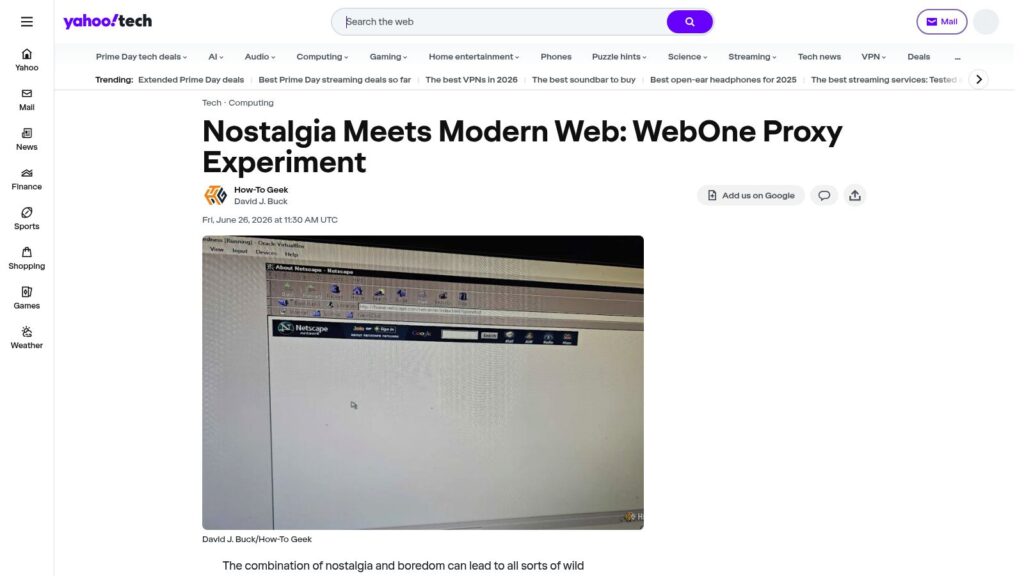
Nostalgia Meets Modern Web: WebOne Proxy Experiment

WebOne is an HTTP 1.x proxy server that enables classic browsers like Netscape Navigator and Internet Explorer to access modern websites by translating current web content into formats compatible with these legacy browsers. By running the proxy on a modern machine and connecting older browsers through it, users can experience a nostalgic journey browsing early 2000s-style web interfaces, though many modern sites still encounter issues due to disabled scripts and incompatible features. This experiment highlights the potential of WebOne for web preservation and retro computing education, even if it’s not practical for everyday browsing.

https://tech.yahoo.com/computing/articles/nostalgia-meets-modern-webone-proxy-113017292.html

Nostalgia Meets Modern Web: WebOne Proxy Experiment Read More »

Web Browsers on Video Game Consoles

Video game consoles have featured official web browsers since the early days of the internet, evolving from rudimentary, limited tools like the CD-i’s ‘internet-lite’ browser to more integrated and capable systems such as the Nintendo DS’s Opera browser and the Dreamcast’s multiple browser offerings. These browsers often reflected the technical constraints and intended audiences of their consoles, providing insight into both early web development suited for TV displays and the expansion of online connectivity in gaming culture. The article details the history and features of various console browsers from platforms including the Sega Saturn, Apple Bandai Pippin, Nintendo 64, Game Boy Colour, and PlayStation 2, highlighting their significance in the broader narrative of internet access on gaming hardware.

https://vale.rocks/posts/game-console-browsers

Web Browsers on Video Game Consoles Read More »

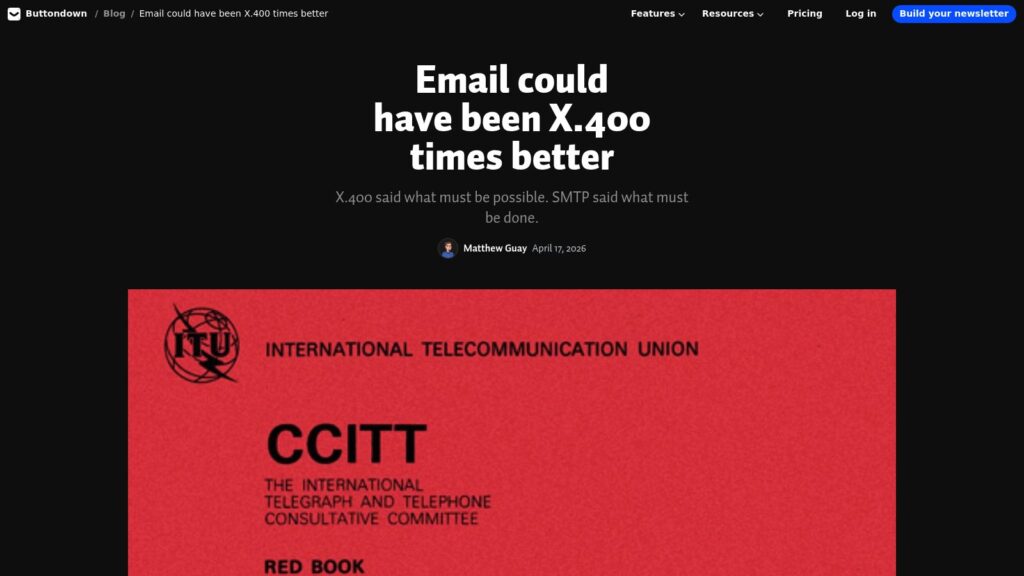
Email Could Have Been X.400 Times Better

The article explores how the X.400 email standard, developed in 1984, included many advanced email features such as message recall, scheduling, encryption, and multilingual support long before SMTP-based internet email adopted them. However, due to its complex, top-down design and difficult implementation, X.400 failed to achieve widespread interoperability and usability, allowing the simpler, more adaptable SMTP protocol to become the foundation of modern email despite lacking some of X.400’s richer features.

https://buttondown.com/blog/x400-vs-smtp-email

Email Could Have Been X.400 Times Better Read More »

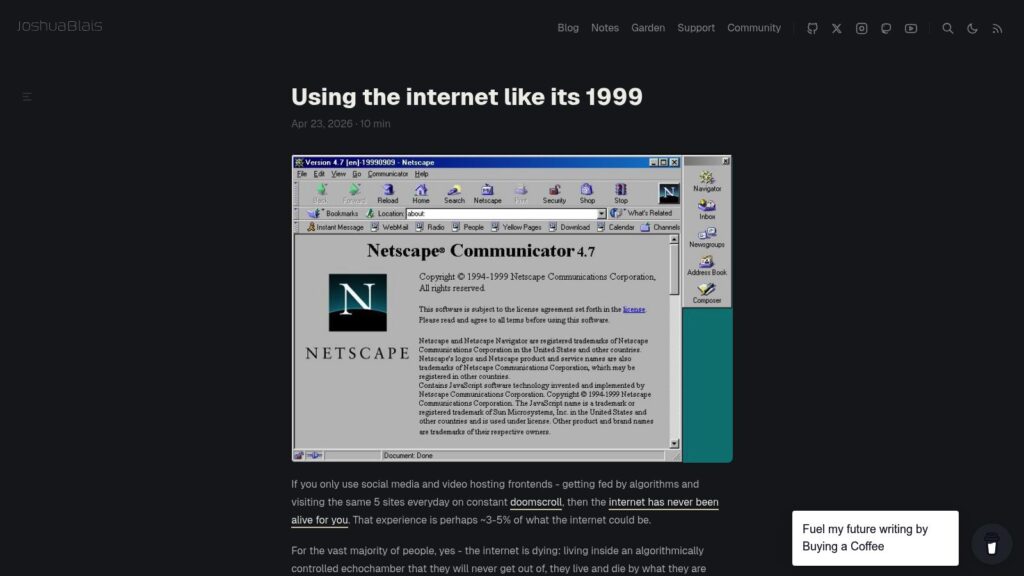
Using the Internet Like It’s 1999

The article argues that the modern internet, dominated by social media algorithms and AI-generated content, has become a less authentic, attention-extracting environment, causing users to lose true engagement and agency. It advocates for returning to an internet usage style reminiscent of 1999, focusing on protocols like RSS, IRC, and email to regain control over content consumption, prioritize real human interaction, and reduce reliance on manipulative platforms. This approach aims to revive a more genuine and sovereign internet experience, countering the current trend of distraction and artificiality.

https://joshblais.com/blog/using-the-internet-like-its-1999/

Using the Internet Like It’s 1999 Read More »

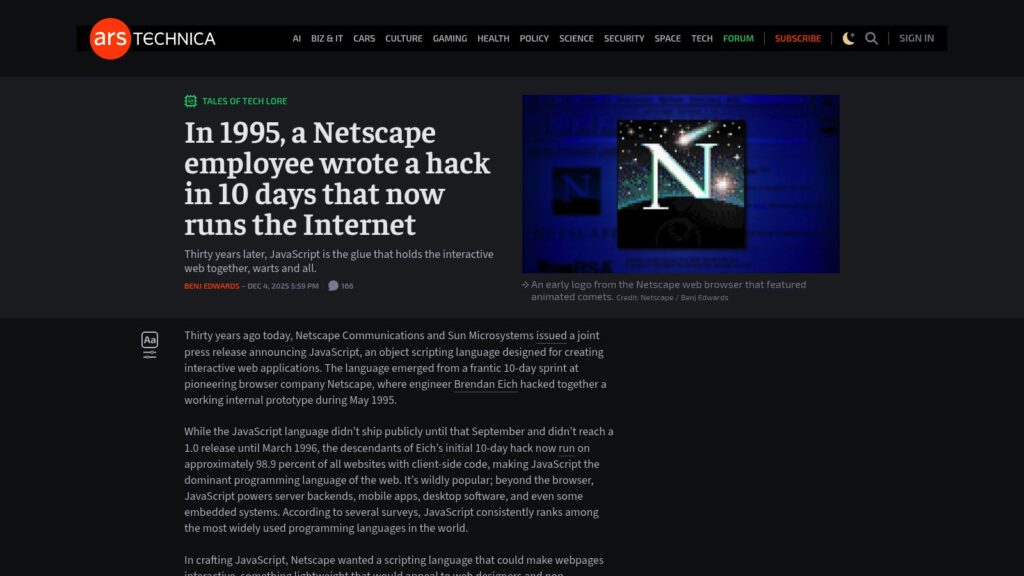
In 1995, a Netscape Employee Wrote a Hack in 10 Days That Now Runs the Internet

In 1995, Netscape’s Brendan Eich developed JavaScript in 10 days to create interactive web applications. Officially released later that year, it has since become dominant, powering 98.9% of websites, server backends, and beyond. Initially called Mocha, it was rebranded to JavaScript to leverage Java’s popularity. Despite its quirks and early industry conflicts, JavaScript has evolved into the most used programming language, now facing a trademark issue with Oracle, which has led to a petition for the name’s public use. JavaScript’s success continues, marking its 30th anniversary as a foundational web technology.

https://arstechnica.com/gadgets/2025/12/in-1995-a-netscape-employee-wrote-a-hack-in-10-days-that-now-runs-the-internet/

In 1995, a Netscape Employee Wrote a Hack in 10 Days That Now Runs the Internet Read More »

Memories of .us

Memories of elementary school include various personal experiences and the evolution of computer networking. The text discusses the development and structure of the Domain Name System (DNS), explaining how it was initially hierarchical for convenience but has become outdated. The history of TLDs, particularly the U.S. ccTLD “.us” and its comparison to other TLDs, reveals a misalignment between intended organization and actual practice. Problems like user-friendliness, government policies, and the influence of private entities have hindered the adoption of more intricate hierarchical names in favor of simpler, accessible ones. Overall, the text reflects on the complexities and failures of DNS organization, emphasizing how historical decisions shaped its current state.

https://computer.rip/2025-11-11-dot-us.html

Memories of .us Read More »

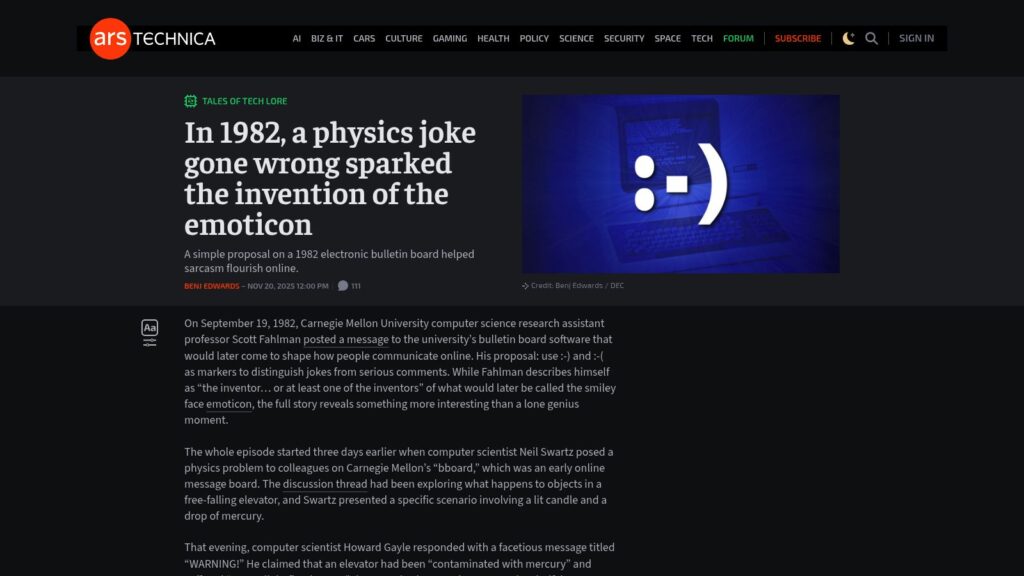
In 1982, a Physics Joke Gone Wrong Sparked the Invention of the Emoticon

In 1982, Scott Fahlman’s post on Carnegie Mellon’s bulletin board introduced emoticons 🙂 and 🙁 to distinguish jokes from serious comments. This innovation arose from a prior misunderstanding of a joke about a physics problem, highlighting the need for clarity in text-based communication. Fahlman’s concise proposal synthesized ideas from earlier discussions and was easily adopted across networks, ultimately leading to the widespread use of emoticons and later emojis in digital communication.

https://arstechnica.com/gadgets/2025/11/in-1982-a-physics-joke-gone-wrong-sparked-the-invention-of-the-emoticon/

In 1982, a Physics Joke Gone Wrong Sparked the Invention of the Emoticon Read More »

Explaining, at Some Length, Techmeme’s 20 Years of Consistency

Techmeme celebrates its 20th anniversary as a consistent news aggregator for the tech industry, linking key reports and social media perspectives. Despite challenges like paywalls and social media fragmentation, it remains a shared resource amidst evolving media landscapes. The site plans to enhance participation, customization, and expansion while recognizing that journalism continues to play a crucial role in tech news.

https://news.techmeme.com/250912/20-years

Explaining, at Some Length, Techmeme’s 20 Years of Consistency Read More »

History of Internet: Ubiquity’s Seamless Web

The Internet has evolved through 7 phases:

  1. Original Internet: 1970s connection of computer networks enabling collaboration.
  2. Mobile Internet: 2000s portability via smartphones connecting billions.
  3. Internet of Things (IoT): All devices interconnected, enhancing various sectors.
  4. Internet of AI Agents: Active AI systems shaping economies through interaction.
  5. Internet of Senses: Multisensory experiences and integrated perception.
  6. Ubiquitous Internet: Seamless global connectivity across remote areas.
  7. Quantum Internet: Future connectivity with quantum communication enhancing security and capabilities.

Each phase builds on the last, transforming how we connect and interact with technology, ultimately leading to an intelligent and universally accessible digital landscape.

https://spectrum.ieee.org/history-of-internet-7-phases

History of Internet: Ubiquity’s Seamless Web Read More »

Scroll to Top