ui

What Was Nice About the UI of Windows 2000

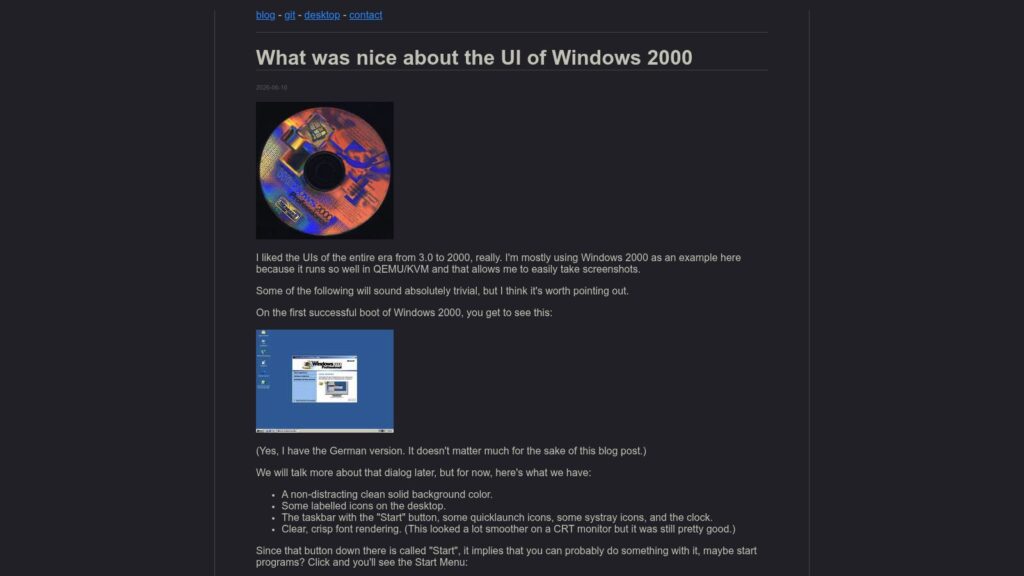
The Windows 2000 UI is praised for its clear, consistent visual design featuring distinct buttons, 3D relief effects, always-visible scrollbars, and well-grouped options that provide immediate, intuitive visual feedback. Its icons and font rendering helped users quickly identify interactive elements and navigate the system easily, contrasting with modern flatter, less obvious interfaces. Despite running slowly on minimal hardware, Windows 2000 offered a balanced, functional, and offline-capable UI that emphasized usability and clarity.

https://movq.de/blog/postings/2026-06-16/0/POSTING-en.html

What Was Nice About the UI of Windows 2000 Read More »

The Windows® 95 User Interface: a Case Study in Usability Engineering

Windows 95’s user interface development involved an interdisciplinary team focusing on iterative design and usability testing. Aimed at enhancing user experience for both beginners and advanced users, the team applied usability engineering principles to address design challenges. The process consisted of exploration, rapid prototyping, and fine-tuning, which allowed for flexibility and continuous improvement based on user feedback. Key findings led to significant design changes, ensuring the interface was intuitive and efficient. The project relied heavily on problem tracking to resolve usability issues, achieving a high fix rate due to team dedication. Ultimately, the iterative approach was crucial for creating a user-friendly operating system that met diverse user needs.

https://dl.acm.org/doi/fullHtml/10.1145/238386.238611

The Windows® 95 User Interface: a Case Study in Usability Engineering Read More »

A Brief History of the Numeric Keypad

Numeric keypad history: Originated from calculators and cash registers, with different layouts (e.g., 9-0 for calculators and 1-3 for phones) due to ergonomic choices, technological constraints, and user familiarity. Key innovations include Jean-Baptiste Schwilgué’s 1844 calculator, Felt’s Comptometer (1884), and Sundstrand’s 3×3 layout (1914). The evolution influenced phone designs, maintaining familiarity in modern devices. Keypad design reflects historical patterns and user preferences.

https://www.doc.cc/articles/a-brief-history-of-the-numeric-keypad

A Brief History of the Numeric Keypad Read More »

Scroll to Top