apple

Steve Jobs Talks iBook, AirPort, and More in Newly Surfaced 1999 Video

A newly surfaced 1999 internal video captures Steve Jobs discussing Apple’s product strategy shortly after the launch of the iBook G3 at Macworld New York, highlighting the completion of Apple’s four-quadrant product lineup and the introduction of AirPort wireless networking developed with Lucent. Jobs emphasized Apple’s advantage in integrating hardware and software to bring innovations like wireless networking and FireWire to market efficiently and stated that the company’s focus was on making great products rather than just financial recovery, aiming to make Apple great again by prioritizing creative professionals, education, and consumers over enterprise markets.

https://www.macrumors.com/2026/03/23/steve-jobs-talks-ibook-airport-and-more/

Steve Jobs Talks iBook, AirPort, and More in Newly Surfaced 1999 Video Read More »

I Don’t Know What Is Apple’s Endgame for the Fn/Globe Key, and I’m Not Sure Apple Knows Either

Apple’s Fn/Globe key evolution reflects its struggle with modifier key functionality. Originally designed to simulate missing keys on compact keyboards, the Fn key expanded tasks but lacked standardization across devices. With the introduction of the Globe key on iPads and Macs, Apple introduced new shortcuts, but inconsistencies between devices and confusing user experiences emerged. The challenge lies in integrating a coherent system across third-party keyboards while managing existing shortcuts, ultimately complicating usage and confusing users. The article urges Apple to reconsider and simplify its approach to modifier keys for improved functionality and user experience.

https://aresluna.org/fn/

I Don’t Know What Is Apple’s Endgame for the Fn/Globe Key, and I’m Not Sure Apple Knows Either Read More »

Macbook Neo Shows How Far Apple’s Repairability Design Has Fallen

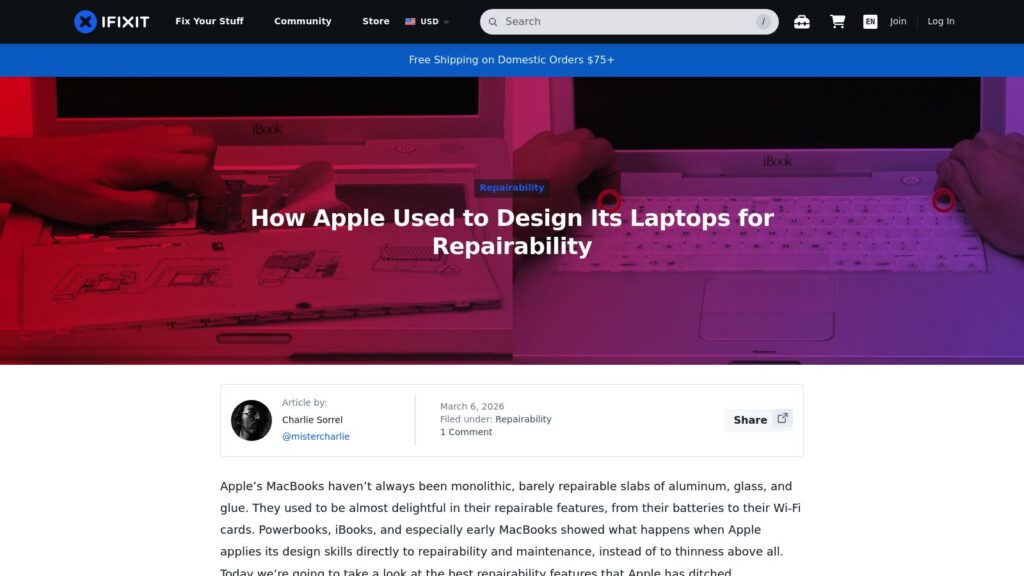
iFixit offers guides, forums, teardowns, and a repair assistant for fixing items. It promotes community involvement and the Right to Repair movement, while providing a range of quality parts and tools in its store. The article discusses how Apple’s early laptops were designed for repairability, featuring easily replaceable keyboards, batteries, RAM, and storage, in contrast to current models that prioritize design over maintenance. The need for modular components is emphasized as essential for longevity and usability, especially in a rapidly evolving tech landscape.

https://www.ifixit.com/News/115995/how-apple-used-to-design-its-laptops-for-repairability

Macbook Neo Shows How Far Apple’s Repairability Design Has Fallen Read More »

Art Bits From HyperCard

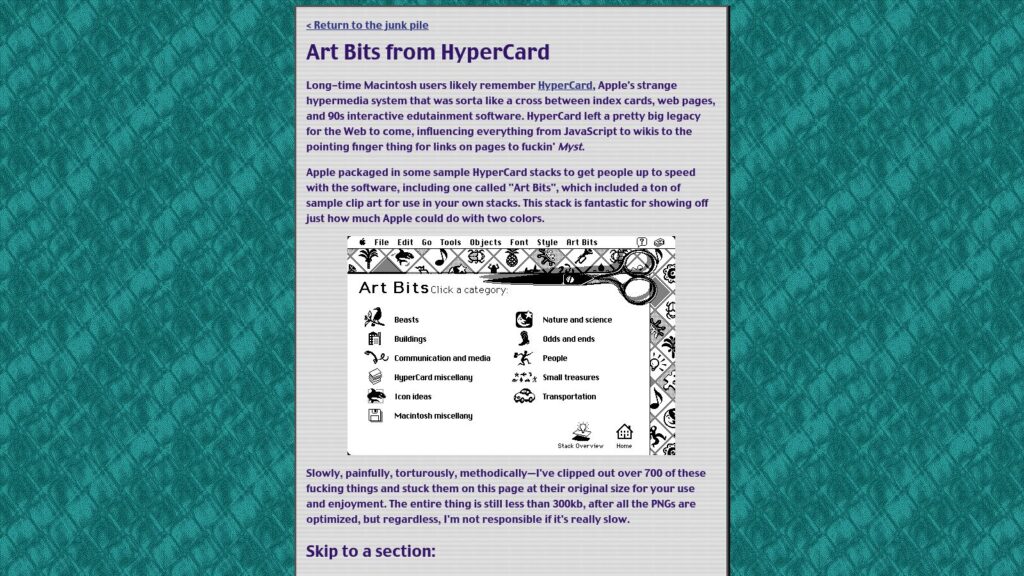
HyperCard, Apple’s early hypermedia system, influenced web development significantly. It included sample stacks like “Art Bits,” showcasing two-color clip art. Over 700 images from this collection have been optimized and shared online for users’ enjoyment, maintaining a small size. Categories include beasts, buildings, media, and more, each containing various clip art examples.

https://archives.somnolescent.net/web/mari_v2/junk/hypercard/

Art Bits From HyperCard Read More »

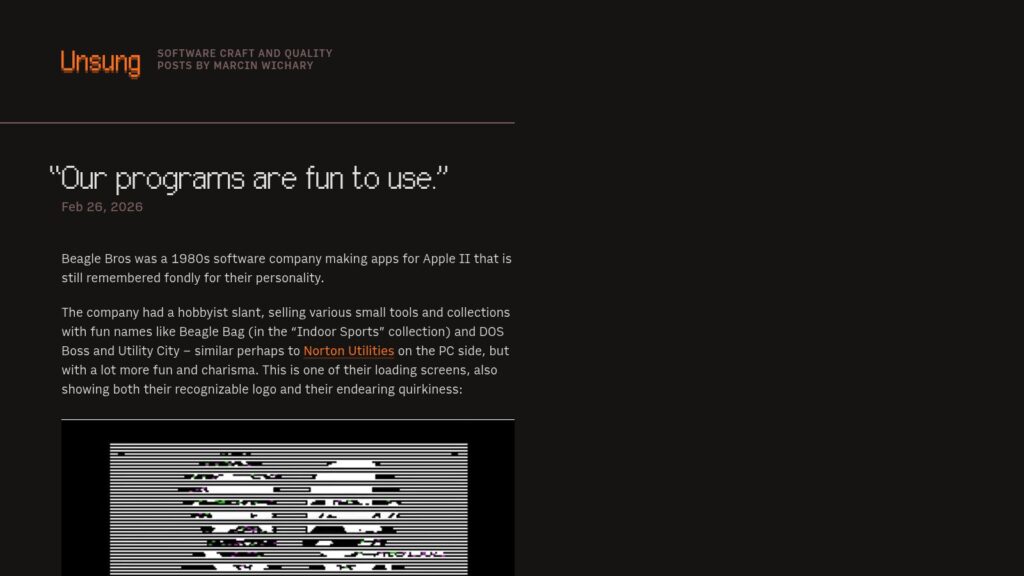
“Our Programs Are Fun to Use.”

Beagle Bros, a nostalgic 1980s software company for Apple II, was known for its quirky and fun applications. Their products combined practical tools with whimsical design, fostering a playful programming environment. Despite their eventual decline due to competition, their legacy inspires a community that values creativity in software development, illustrated by the ongoing interest in their catalog.

https://unsung.aresluna.org/our-programs-are-fun-to-use/

“Our Programs Are Fun to Use.” Read More »

“Just a Little Detail That Wouldn’t Sell Anything”

“Sleep Indicator Light,” first seen on the iBook G3 in 1999, evolved through Apple products to signify sleep status with a breathing animation. Despite its artistic touch, it was phased out in the 2010s. The light served practical purposes, but its organic design is missed, highlighting the importance of meaningful details in tech.

https://unsung.aresluna.org/just-a-little-detail-that-wouldnt-sell-anything/

“Just a Little Detail That Wouldn’t Sell Anything” Read More »

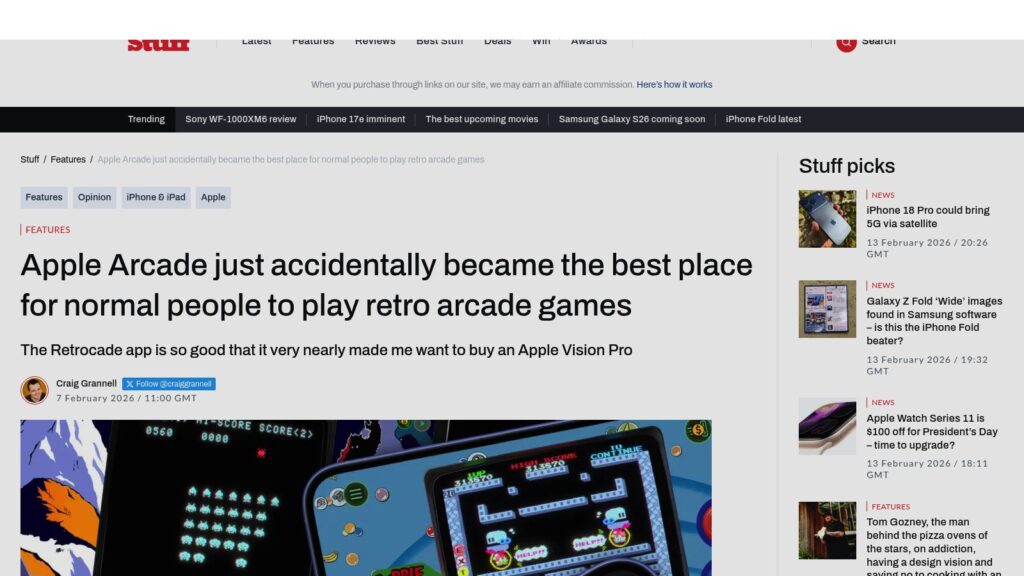
Apple Arcade Just Accidentally Became the Best Place for Normal People to Play Retro Arcade Games

Apple Arcade now features Retrocade, a top app for playing retro arcade games. It offers classic titles like Pac-Man and Asteroids with excellent controls, daily challenges, and global high scores. However, it lacks certain features like multiplayer and Mac support. Despite its limitations, it signals a shift in Apple’s gaming strategy towards embracing retro gaming without the hassle of emulation. The app costs $6.99/month or as part of Apple One.

https://www.stuff.tv/features/apple-arcade-just-accidentally-became-the-best-place-for-normal-people-to-play-retro-arcade-games/

Apple Arcade Just Accidentally Became the Best Place for Normal People to Play Retro Arcade Games Read More »

The Rise and Fall of Apple’s Mac Clones Era

Apple briefly allowed Mac clones in the 1990s to respond to a competitive PC market but quickly withdrew due to concerns over brand integrity and sales. The clone era lasted from 1995 to 1997, enabling third parties, like Power Computing, to legally produce Macintosh-compatible computers. However, the effort ultimately failed as these clones undercut Apple’s market, leading to significant financial losses. Upon Steve Jobs’ return, Apple ended the clone program to regain control over its ecosystem, revealing the pitfalls of licensing its operating system to competitors.

https://spectrum.ieee.org/apple-mac-clones-history

The Rise and Fall of Apple’s Mac Clones Era Read More »

The Microsoft SoftCard for the Apple II: Getting Two Processors to Share the Same Memory

Microsoft’s Z-80 SoftCard allowed Apple II users to run CP/M software by utilizing a secondary Zilog Z80 processor, facilitating memory sharing and enabling coexistence with the existing 6502 processor. The SoftCard remapped memory to avoid conflicts and included a detailed manual for programming, including challenges of managing interrupts and memory addresses.

https://devblogs.microsoft.com/oldnewthing/20251104-00/?p=111758

The Microsoft SoftCard for the Apple II: Getting Two Processors to Share the Same Memory Read More »

Scroll to Top