technology

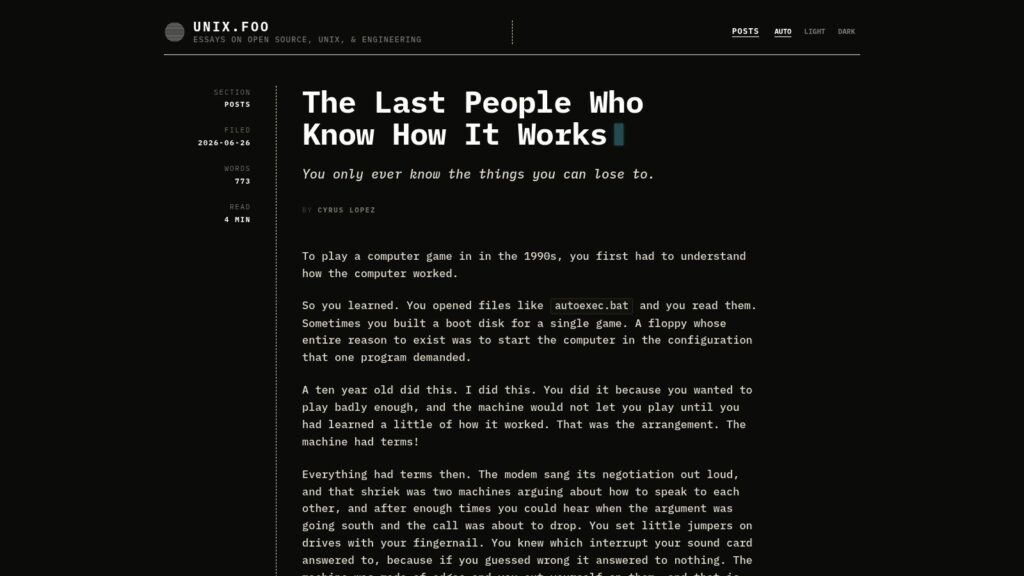
The Last People Who Know How It Works

In the 1990s, engaging with computers required deep, hands-on knowledge of their workings, from editing configuration files to troubleshooting hardware conflicts, fostering an intimate understanding through challenge and effort. Today’s AI-driven machines, by contrast, remove these barriers by anticipating and accommodating user needs without requiring technical struggle, resulting in people becoming more dependent yet less familiar with the underlying systems. This shift marks the end of an era where intimate acquaintance with technology arose from overcoming its difficulties, highlighting a cultural loss experienced by older generations but unnoticed by younger users accustomed to seamless, frictionless tools.

https://unix.foo/posts/last-people-who-know-how-it-works/

The Last People Who Know How It Works Read More »

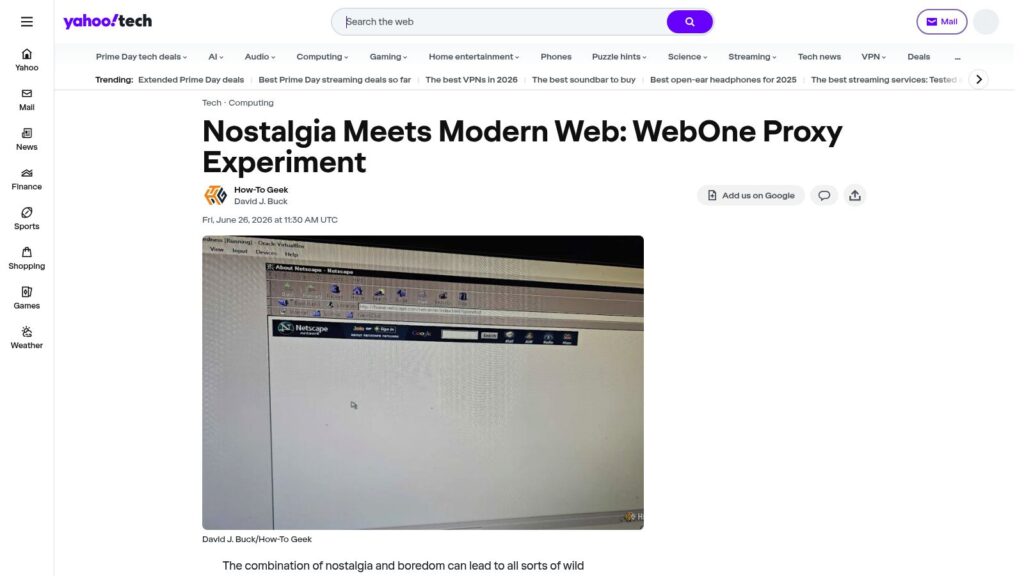
Nostalgia Meets Modern Web: WebOne Proxy Experiment

WebOne is an HTTP 1.x proxy server that enables classic browsers like Netscape Navigator and Internet Explorer to access modern websites by translating current web content into formats compatible with these legacy browsers. By running the proxy on a modern machine and connecting older browsers through it, users can experience a nostalgic journey browsing early 2000s-style web interfaces, though many modern sites still encounter issues due to disabled scripts and incompatible features. This experiment highlights the potential of WebOne for web preservation and retro computing education, even if it’s not practical for everyday browsing.

https://tech.yahoo.com/computing/articles/nostalgia-meets-modern-webone-proxy-113017292.html

Nostalgia Meets Modern Web: WebOne Proxy Experiment Read More »

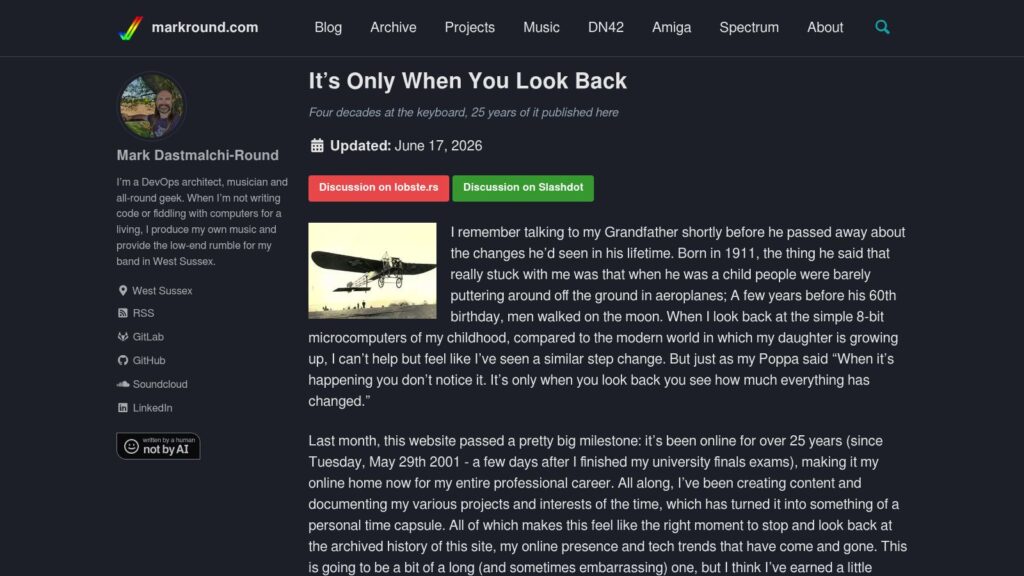
It’s Only When You Look Back

Mark Dastmalchi-Round reflects on 40 years of computing, tracing his journey from coding on a Sinclair ZX Spectrum to managing modern cloud-native projects. He chronicles key personal and technological milestones—including early BBS experiences, working with Amiga and Unix-like systems, navigating the rise of the internet and open source, and evolving web development practices—while preserving an extensive archive of his online presence spanning 25 years. His account highlights the rapid evolution of hardware, software, and online communities, capturing a vivid panorama of computing history through a personal lens.

https://www.markround.com/blog/2026/06/17/25-its-only-when-you-look-back/

It’s Only When You Look Back Read More »

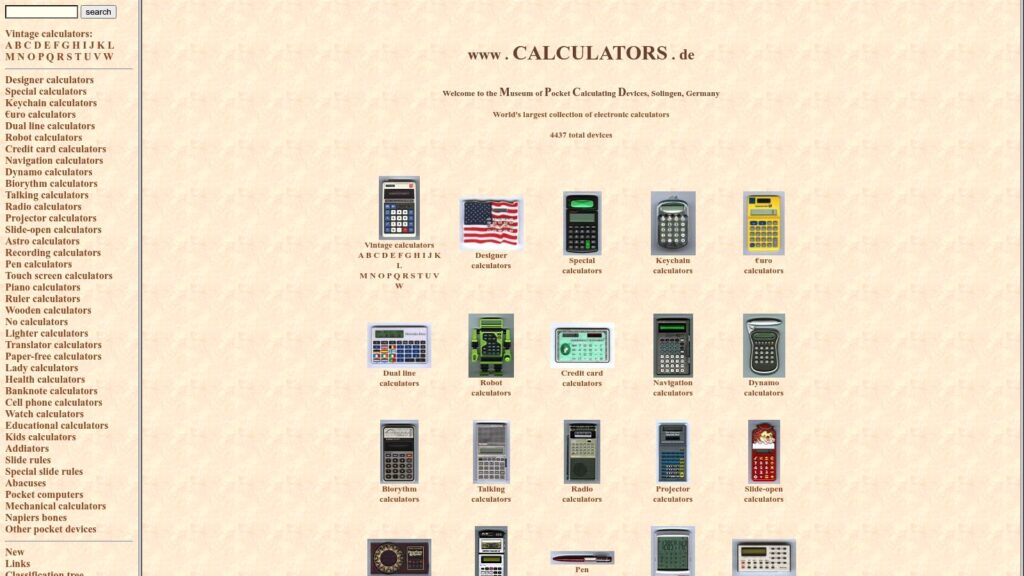
Museum of Pocket Calculating Devices

The Museum of Pocket Calculating Devices showcases a diverse collection of calculators and related tools, including slide rules, addiators, and abacuses from various brands such as Casio, Hewlett Packard, Texas Instruments, and Sharp. The museum highlights the history, technology, and evolution of pocket calculators and scientific computing devices, featuring vintage models with LED, LCD, and solar functionalities, reflecting their significance in scientific and everyday calculations.

https://www.calculators.de/

Museum of Pocket Calculating Devices Read More »

Every GPU That Mattered

The article presents a comprehensive timeline and comparison of 49 significant consumer GPUs launched over 30 years, from 1996 to 2025, highlighting key technical specifications, defining games, and market impacts of each generation. It showcases the evolution of GPU technology from the pioneering 3D accelerators like the 3dfx Voodoo Graphics to modern high-performance models such as NVIDIA’s RTX 5090, revealing trends in transistor count, memory, power consumption, and pricing, while also reflecting on user adoption through Steam Hardware Survey data.

https://sheets.works/data-viz/every-gpu

Every GPU That Mattered Read More »

Apple Has Archives Even Tim Cook Didn’t Know About. We Went Inside

To celebrate its 50th anniversary, Apple CEO Tim Cook shared rare prototypes and archives of iconic products like the iPod and iPhone with The Wall Street Journal. Cook reflected on the company’s journey, including successes, failures, and a special project from Steve Jobs, while offering insights and advice for the future leadership of Apple.

https://www.youtube.com/watch?v=74qPQt_5DdM

Apple Has Archives Even Tim Cook Didn’t Know About. We Went Inside Read More »

The Most Important Software Innovations

David A. Wheeler’s paper identifies the most important software innovations by focusing strictly on technological innovations that have had widespread and critical impact on programming, deliberately excluding hardware advances and non-technological developments such as legal or social inventions. The paper also argues that software patents have largely failed to promote innovation, often covering obvious ideas or prior art, and have instead impeded software development, with most key software innovations never patented; this challenges the effectiveness of patents as incentives in the software industry.

https://dwheeler.com/innovation/innovation.html

The Most Important Software Innovations Read More »

Scroll to Top