November 2025

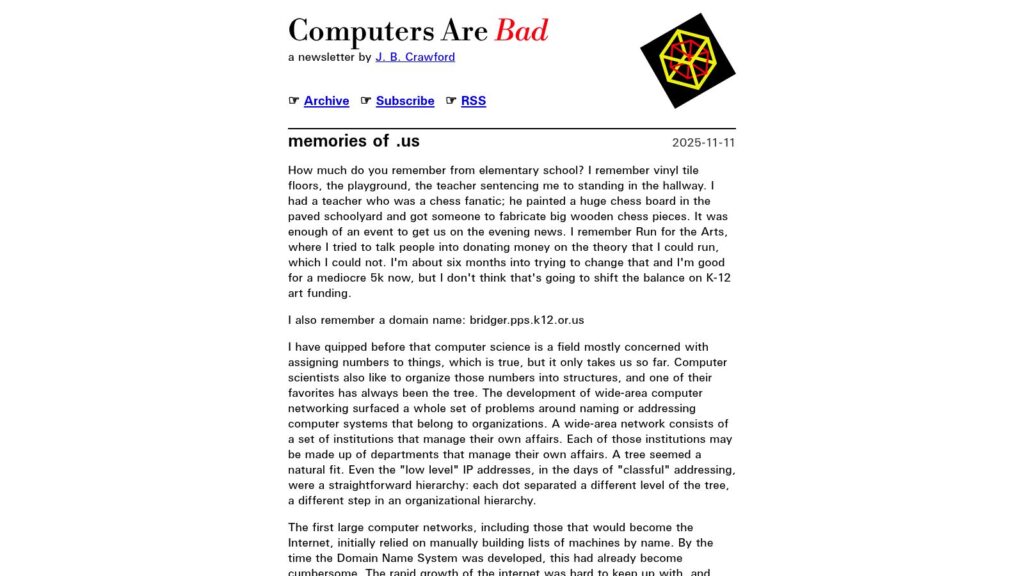
Memories of .us

Memories of elementary school include various personal experiences and the evolution of computer networking. The text discusses the development and structure of the Domain Name System (DNS), explaining how it was initially hierarchical for convenience but has become outdated. The history of TLDs, particularly the U.S. ccTLD “.us” and its comparison to other TLDs, reveals a misalignment between intended organization and actual practice. Problems like user-friendliness, government policies, and the influence of private entities have hindered the adoption of more intricate hierarchical names in favor of simpler, accessible ones. Overall, the text reflects on the complexities and failures of DNS organization, emphasizing how historical decisions shaped its current state.
https://computer.rip/2025-11-11-dot-us.html

Memories of .us Read More »

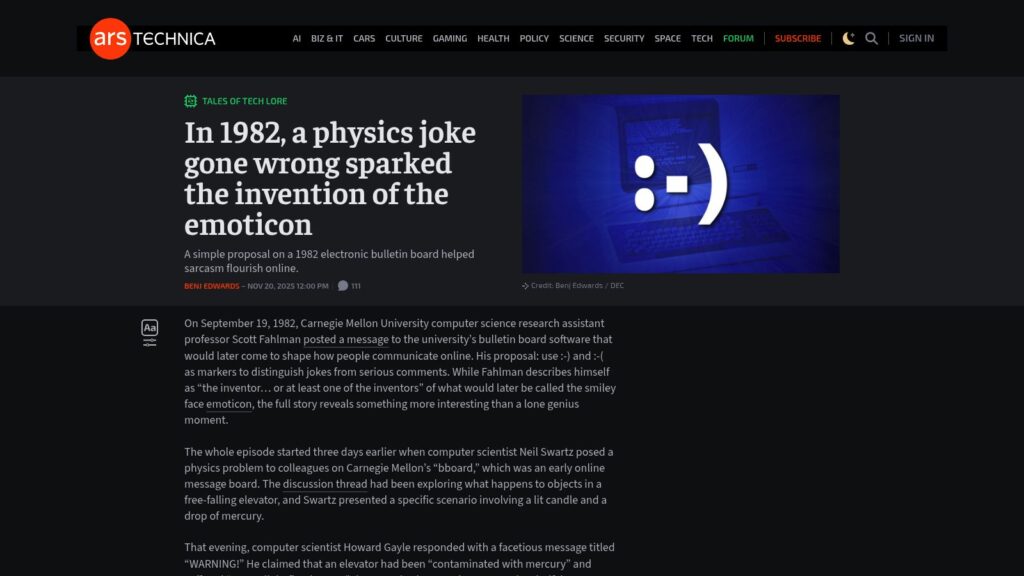
In 1982, a Physics Joke Gone Wrong Sparked the Invention of the Emoticon

In 1982, Scott Fahlman’s post on Carnegie Mellon’s bulletin board introduced emoticons 🙂 and 🙁 to distinguish jokes from serious comments. This innovation arose from a prior misunderstanding of a joke about a physics problem, highlighting the need for clarity in text-based communication. Fahlman’s concise proposal synthesized ideas from earlier discussions and was easily adopted across networks, ultimately leading to the widespread use of emoticons and later emojis in digital communication.

https://arstechnica.com/gadgets/2025/11/in-1982-a-physics-joke-gone-wrong-sparked-the-invention-of-the-emoticon/

In 1982, a Physics Joke Gone Wrong Sparked the Invention of the Emoticon Read More »

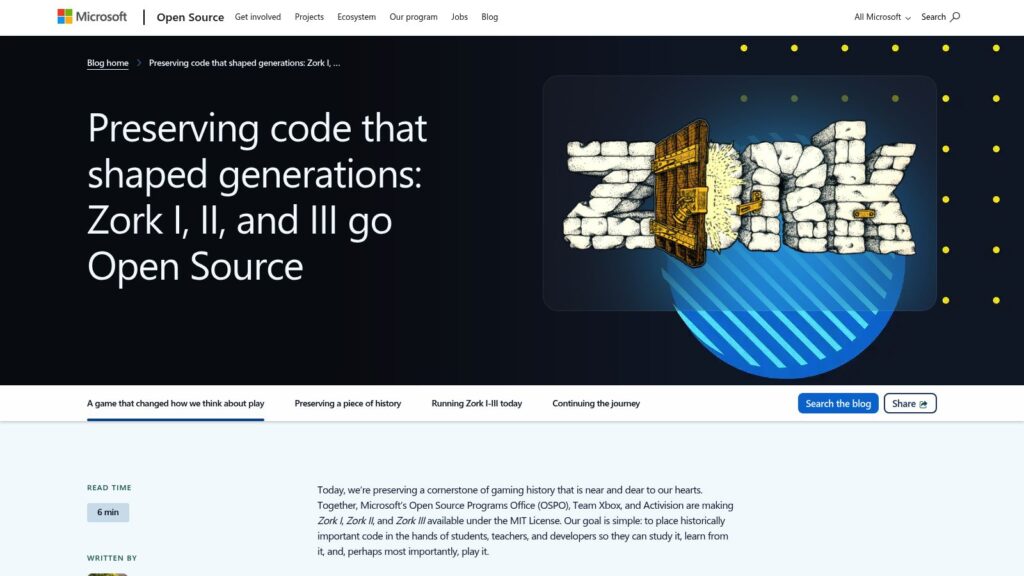
Preserving Code That Shaped Generations: Zork I, II, and III Go Open Source

Zork I, II, and III now open-source under MIT License by Microsoft and Activision to preserve gaming history, allowing study and play. The Z-Machine engine revolutionized gaming with cross-platform compatibility. Source code and documentation available on GitHub, excluding commercial content. Zork remains accessible through commercial platforms and modern interpreters like ZILF. The initiative encourages community contributions for education and exploration, honoring the original creators and preserving a significant cultural artifact.

https://opensource.microsoft.com/blog/2025/11/20/preserving-code-that-shaped-generations-zork-i-ii-and-iii-go-open-source

Preserving Code That Shaped Generations: Zork I, II, and III Go Open Source Read More »

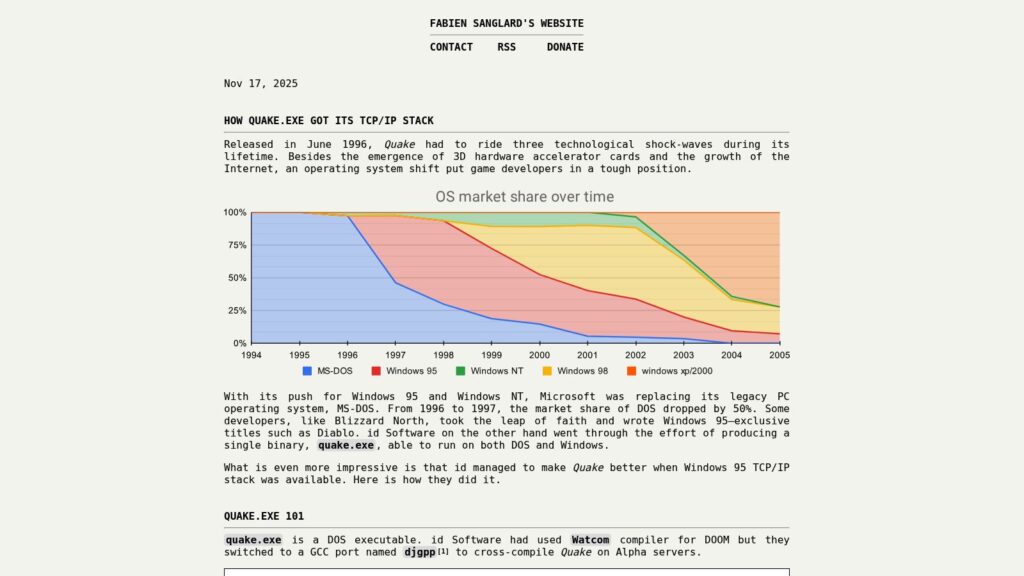
How Quake.exe Got Its TCP/IP Stack

Extreme TLDR:
Quake (1996) was developed to run on both DOS and Windows 95 using a single executable, quake.exe. It relied on the djgpp compiler for DOS compatibility, integrating with Windows 95’s DPMI for enhanced performance. Multiplayer support included IPX and TCP/IP, although TCP/IP was challenging to set up on DOS. Mpath’s Chunnel allowed Quake to connect via Windows’ TCP stack, leading to online gaming capabilities. The architecture was complex, involving DLLs and virtual device drivers to facilitate communication between DOS executables and Windows networking. Subsequent versions of Quake moved to native Win32 support.

https://fabiensanglard.net/quake_chunnel/index.html

How Quake.exe Got Its TCP/IP Stack Read More »

The Rise and Fall of Apple’s Mac Clones Era

Apple briefly allowed Mac clones in the 1990s to respond to a competitive PC market but quickly withdrew due to concerns over brand integrity and sales. The clone era lasted from 1995 to 1997, enabling third parties, like Power Computing, to legally produce Macintosh-compatible computers. However, the effort ultimately failed as these clones undercut Apple’s market, leading to significant financial losses. Upon Steve Jobs’ return, Apple ended the clone program to regain control over its ecosystem, revealing the pitfalls of licensing its operating system to competitors.

https://spectrum.ieee.org/apple-mac-clones-history

The Rise and Fall of Apple’s Mac Clones Era Read More »

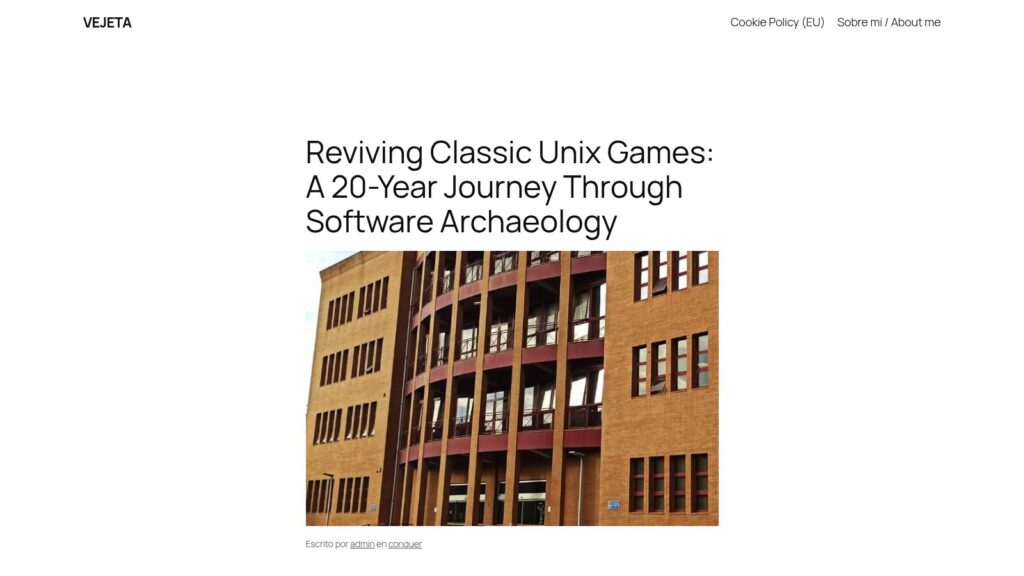
Reviving Classic Unix Games: a 20-Year Journey Through Software Archaeology

The article recounts a two-decade quest to preserve the 1987 Unix game Conquer. The author traced, contacted, and obtained permissions from the original creators and contributors to relicense the code under GPLv3. During this journey, the author modernized the codebase and leveraged contemporary build and packaging tools to make the game easily accessible on modern Linux distributions. The project highlights challenges in archiving software, the importance of clear licensing and documentation, and the community’s role in preservation. Now, both classic and updated versions are available with modern packaging, bridging the past and future for developers.

https://vejeta.com/reviving-classic-unix-games-a-20-year-journey-through-software-archaeology/

Reviving Classic Unix Games: a 20-Year Journey Through Software Archaeology Read More »

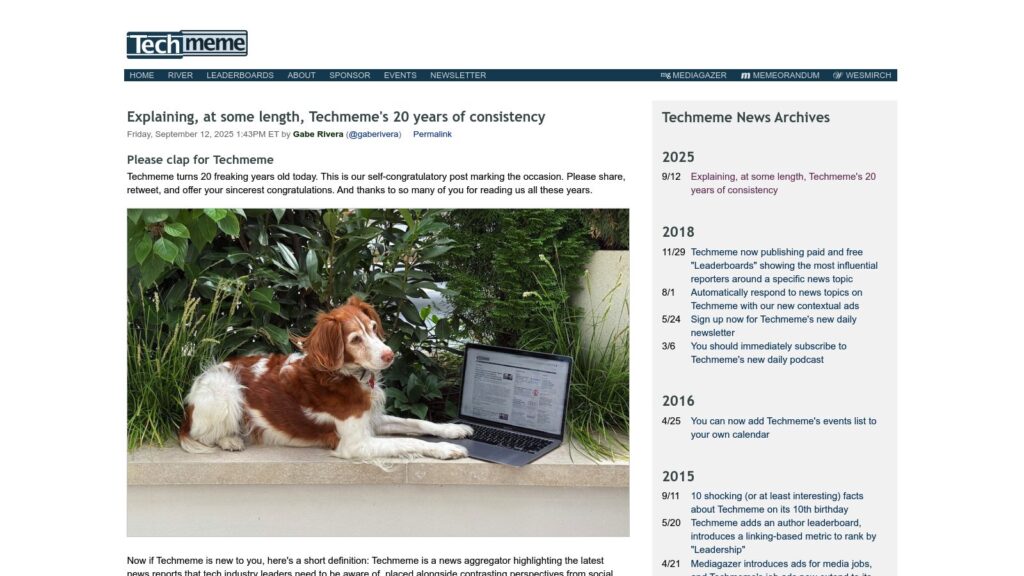
Explaining, at Some Length, Techmeme’s 20 Years of Consistency

Techmeme celebrates its 20th anniversary as a consistent news aggregator for the tech industry, linking key reports and social media perspectives. Despite challenges like paywalls and social media fragmentation, it remains a shared resource amidst evolving media landscapes. The site plans to enhance participation, customization, and expansion while recognizing that journalism continues to play a crucial role in tech news.

https://news.techmeme.com/250912/20-years

Explaining, at Some Length, Techmeme’s 20 Years of Consistency Read More »

Scroll to Top