linux

Desktopcolors.com – Desktop Background Colors, by Operating System
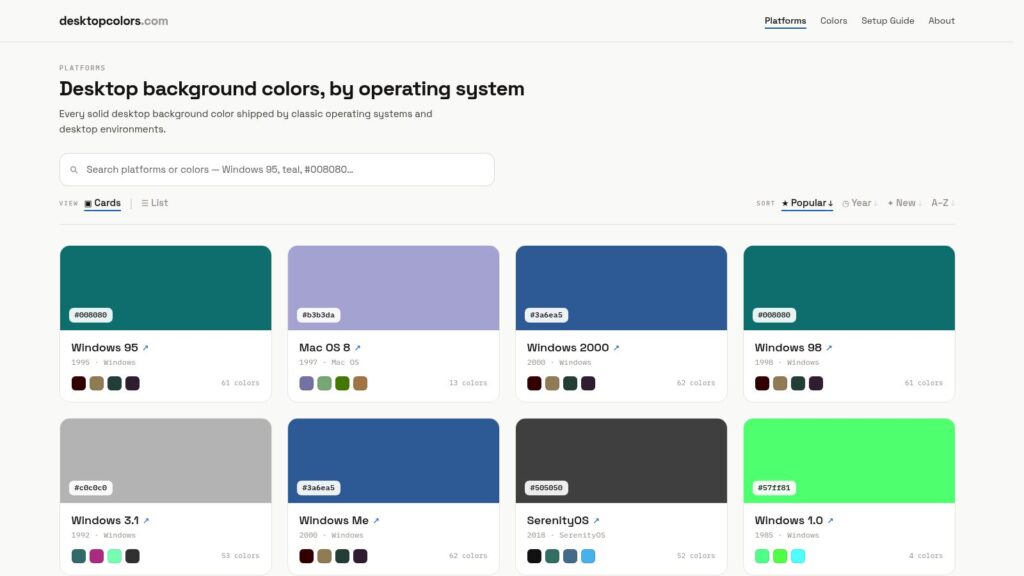
Desktopcolors.com is an online archive cataloging every solid desktop background color used by classic operating systems and desktop environments, spanning 229 colors across 26 platforms. The site provides categorized collections from systems like Windows 95, Mac OS 8, Amiga Workbench, and others, serving as a nostalgic resource that documents the visual history of desktop computing aesthetics. It includes setup guides and platform listings, and it accepts community contributions through its GitHub repository.

https://desktopcolors.com/

Desktopcolors.com – Desktop Background Colors, by Operating System Read More »

Press Start: How Controllers Shaped Video Game Design—and Where Interfaces May Go Next

Game controllers have shaped video game interfaces, evolving from simple designs to complex navigational systems. Modern gaming incorporates varied features, enhancing player experience while maintaining intuitive interaction through consistent controller layouts. As technology advances with AR/VR, these navigation principles can inform broader UI design across platforms, emphasizing user engagement and seamless accessibility.

https://www.figma.com/blog/press-start-video-game-navigation/

Press Start: How Controllers Shaped Video Game Design—and Where Interfaces May Go Next Read More »

Understanding the Bin, Sbin, Usr/bin , Usr/sbin Split

Busybox’s directory structure (bin, sbin, usr/bin, usr/sbin) originates from 1970s Unix, where space limitations led to the /usr mount for user files. The split lacks relevancy today due to modern boot processes, shared libraries, and larger storage capacities. Over time, bureaucratic rules developed to justify the structure, but current practice is often arbitrary. Developers like Rob Landley simplify their systems by linking directories for practicality.

https://lists.busybox.net/pipermail/busybox/2010-December/074114.html

Understanding the Bin, Sbin, Usr/bin , Usr/sbin Split Read More »

The Early Days of Linux [LWN.net]

Lars Wirzenius reminisces about the early days of Linux, beginning with his studies at the University of Helsinki and friendship with Linus Torvalds. Initially starting as a small project, Linux grew from exploring Unix and coding simple multitasking examples to the development of a fully functional kernel. Linus’s journey included buying a PC, experimenting with MINIX, and engaging in community collaboration, leading to the eventual public release of Linux in 1991. The introduction of the GNU GPL and support for virtual memory further contributed to Linux’s evolution. Over the years, Linux became a global phenomenon, ultimately running on billions of devices worldwide.

https://lwn.net/Articles/928581/

The Early Days of Linux [LWN.net] Read More »

Scroll to Top