software

Original Apollo 11 Code Open-Sourced by NASA — Original Command Module and Lunar Module Code Repos Are Now Public Domain Resources
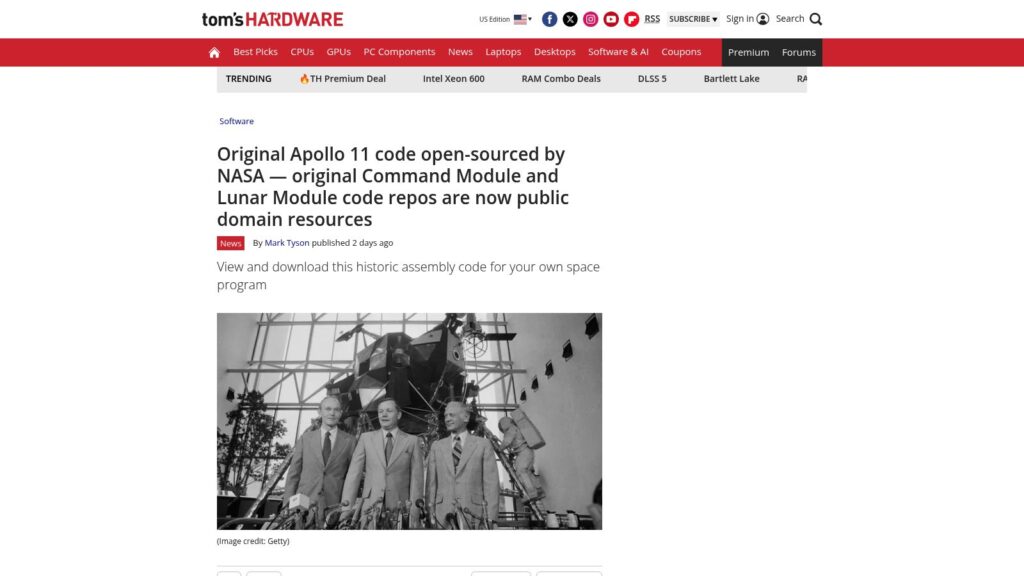
The article reports that NASA has made the original Apollo 11 guidance computer software publicly available, including separate codebases for the Command Module and Lunar Module. The release allows people to study and run the historic assembly-language programs that helped guide the first Moon landing under extremely limited computing resources. The main point is that opening this code preserves an important part of computing history and highlights the efficiency and engineering required for early space missions.
https://www.tomshardware.com/software/original-apollo-11-code-open-sourced-by-nasa-original-command-module-and-lunar-module-code-repos-are-now-public-domain-resources

Original Apollo 11 Code Open-Sourced by NASA — Original Command Module and Lunar Module Code Repos Are Now Public Domain Resources Read More »

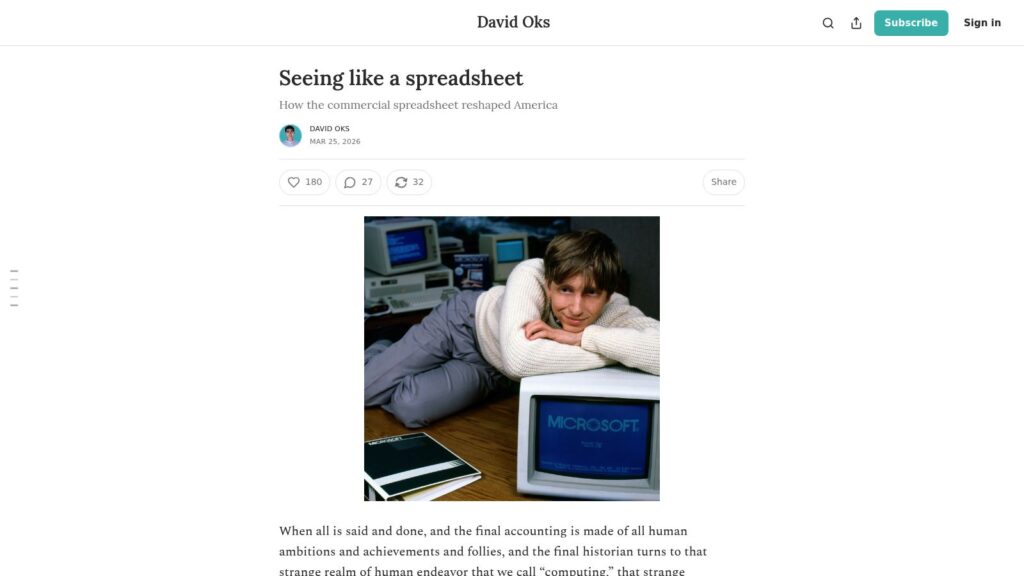
How the Spreadsheet Reshaped America

The electronic spreadsheet, particularly Microsoft Excel, revolutionized American businesses by enabling managers to process information and make data-driven decisions at an unprecedented scale. Before spreadsheets, companies relied on labor-intensive methods like columnar pads to analyze data, limiting their ability to understand complex business dynamics. The advent of VisiCalc, the first electronic spreadsheet, transformed the Apple II into a powerful business tool, enabling instant calculations and complex formulas and ultimately reshaping American corporations.

https://davidoks.blog/p/how-the-spreadsheet-reshaped-america

How the Spreadsheet Reshaped America Read More »

LotusNotes

Lotus Notes originated from the University of Illinois’ PLATO system, a pioneering multi-user, networked computer system emphasizing public collaboration and user-generated content, funded by the military and the NSF. Developed in the 1980s by Ray Ozzie and Iris Associates under Lotus Development, Lotus Notes evolved as a flexible groupware platform blending email, calendaring, and database functions with replication technology inherited from PLATO’s architecture. Despite its initial dominance in enterprise groupware, Lotus Notes declined significantly after IBM’s acquisition, largely due to competition from Microsoft Exchange and shifting industry standards favoring open protocols and web integration.

https://computer.rip/2026-03-14-lotusnotes.html

LotusNotes Read More »

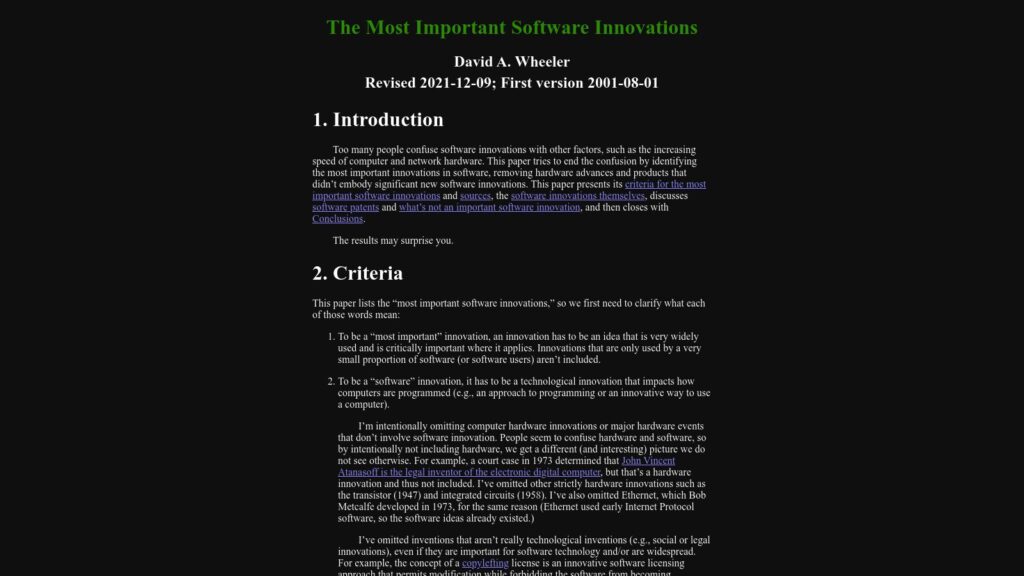
The Most Important Software Innovations

David A. Wheeler’s paper identifies the most important software innovations by focusing strictly on technological innovations that have had widespread and critical impact on programming, deliberately excluding hardware advances and non-technological developments such as legal or social inventions. The paper also argues that software patents have largely failed to promote innovation, often covering obvious ideas or prior art, and have instead impeded software development, with most key software innovations never patented; this challenges the effectiveness of patents as incentives in the software industry.

https://dwheeler.com/innovation/innovation.html

The Most Important Software Innovations Read More »

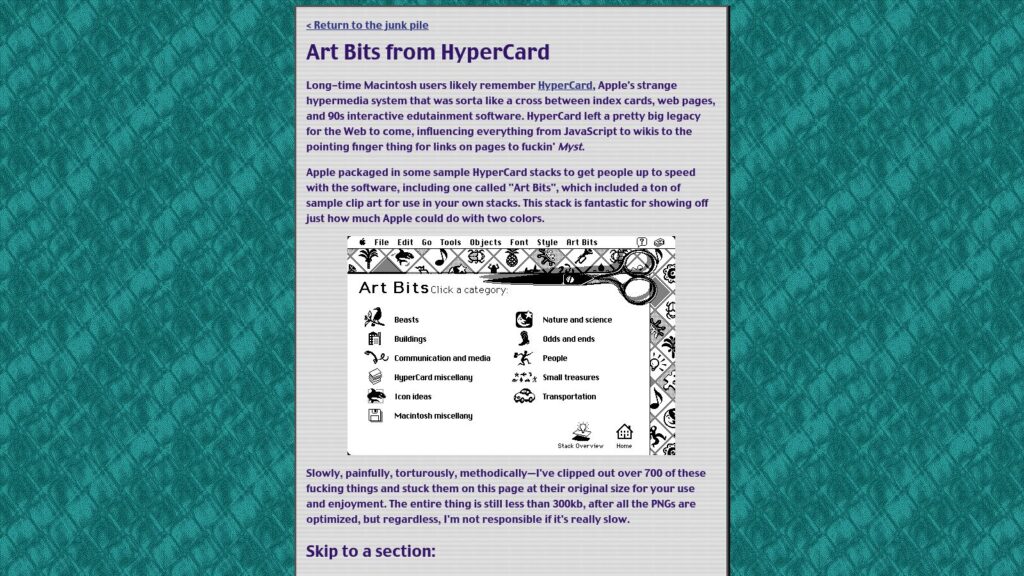
Art Bits From HyperCard

HyperCard, Apple’s early hypermedia system, influenced web development significantly. It included sample stacks like “Art Bits,” showcasing two-color clip art. Over 700 images from this collection have been optimized and shared online for users’ enjoyment, maintaining a small size. Categories include beasts, buildings, media, and more, each containing various clip art examples.

https://archives.somnolescent.net/web/mari_v2/junk/hypercard/

Art Bits From HyperCard Read More »

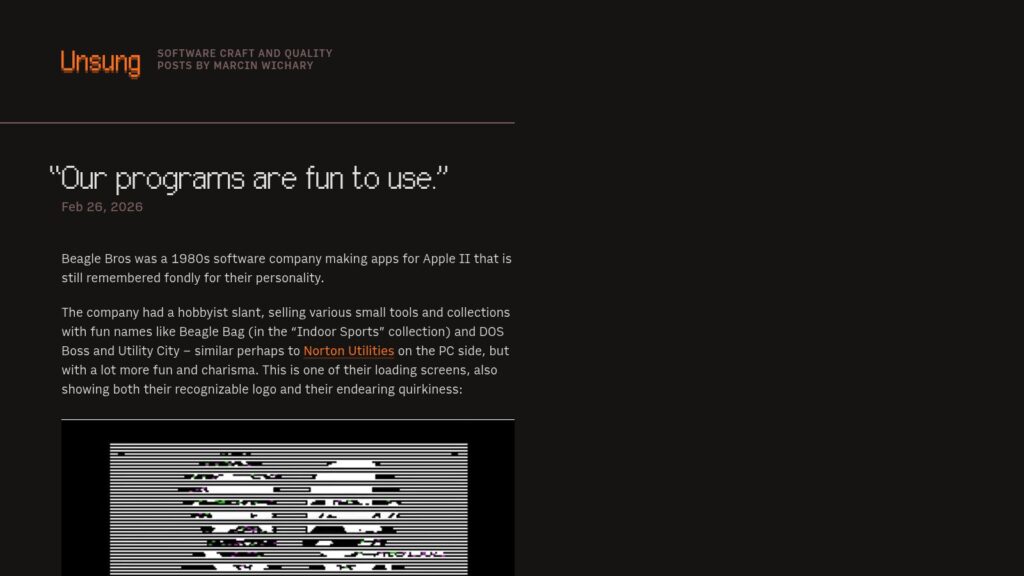
“Our Programs Are Fun to Use.”

Beagle Bros, a nostalgic 1980s software company for Apple II, was known for its quirky and fun applications. Their products combined practical tools with whimsical design, fostering a playful programming environment. Despite their eventual decline due to competition, their legacy inspires a community that values creativity in software development, illustrated by the ongoing interest in their catalog.

https://unsung.aresluna.org/our-programs-are-fun-to-use/

“Our Programs Are Fun to Use.” Read More »

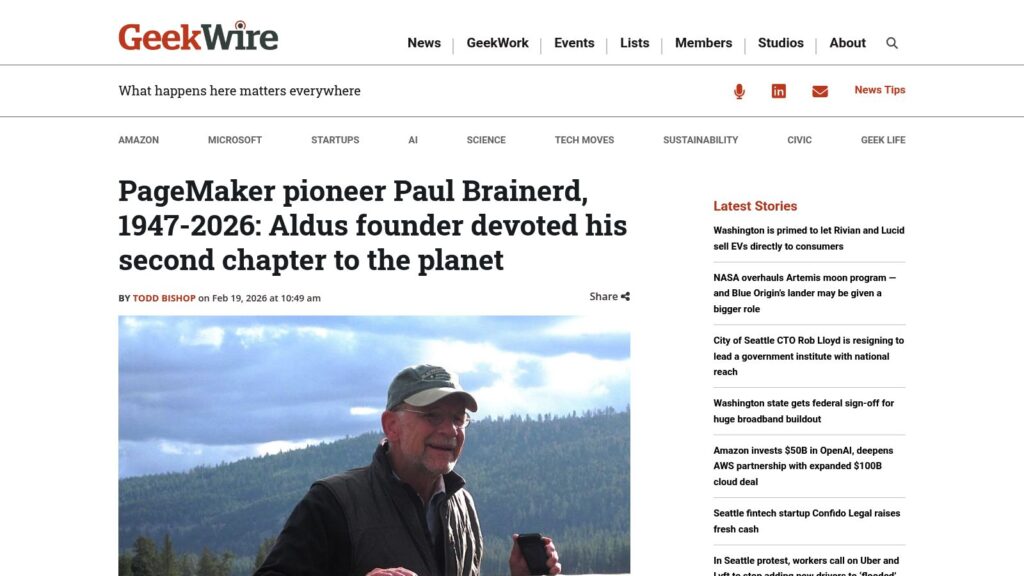
PageMaker Pioneer Paul Brainerd, 1947-2026: Aldus Founder Devoted His Second Chapter to the Planet

Paul Brainerd (1947-2026), founder of Aldus Corporation and pioneer of desktop publishing, died at 78 after battling Parkinson’s disease. He co-created PageMaker, revolutionizing printing for non-professionals and empowering many with desktop publishing tools. Following Aldus’s merger with Adobe in 1994, Brainerd focused on environmental philanthropy, founding the Brainerd Foundation, IslandWood, and supporting various initiatives in the Pacific Northwest and New Zealand. A respected leader and innovator, he significantly impacted both technology and conservation efforts throughout his life.

https://www.geekwire.com/2026/pagemaker-pioneer-paul-brainerd-1947-2026-aldus-founder-devoted-his-second-chapter-to-the-planet/

PageMaker Pioneer Paul Brainerd, 1947-2026: Aldus Founder Devoted His Second Chapter to the Planet Read More »

C64 Graphics Explorer — View C64 Graphics the Authentic Way

C64GraphicsExplorer is a macOS app for exploring modern Commodore 64 art, utilizing CRT simulation and pixel inspection. Users can view curated artwork, analyze creation techniques, and input their images for palette mapping. Features include a gallery of C64 graphics, authentic CRT effects, pixel magnification, mode detection, and adjustable pixel grids. It supports macOS Sequoia 15.0+ on Apple Silicon and maintains user privacy.

https://c64graphicsexplorer.com/

C64 Graphics Explorer — View C64 Graphics the Authentic Way Read More »

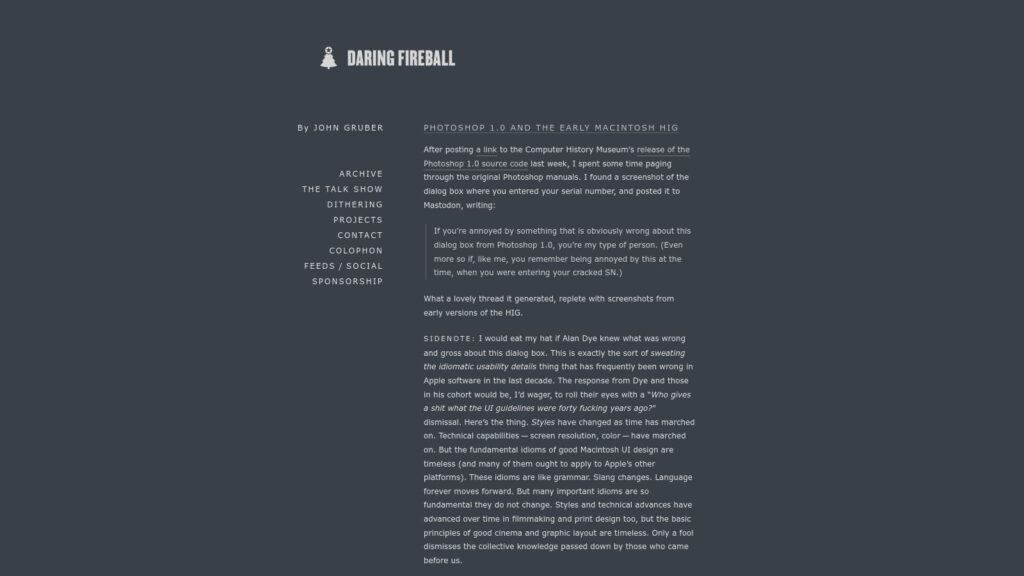
Photoshop 1.0 and the Early Macintosh HIG

Gruber discusses Photoshop 1.0’s source code and early UI details, noting the timelessness of good design principles despite evolving styles and technologies. He critiques modern dismissiveness towards historical UI standards, emphasizing that fundamental design idioms remain relevant.

https://daringfireball.net/linked/2025/12/31/photoshop-1-and-the-early-macintosh-hig

Photoshop 1.0 and the Early Macintosh HIG Read More »

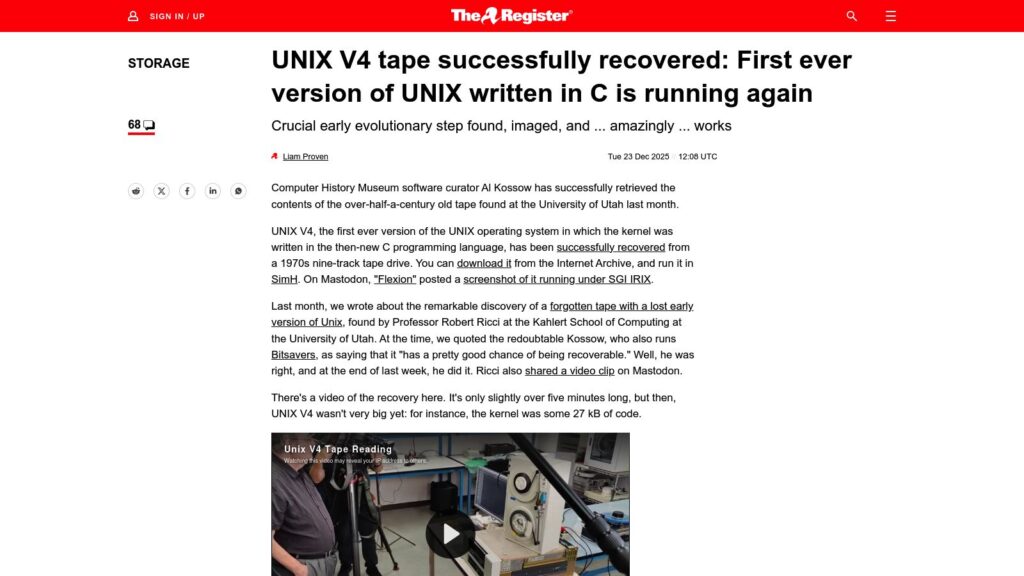
UNIX V4 Tape Successfully Recovered: First Ever Version of UNIX Written in C Is Running Again

UNIX V4, the first version of UNIX with a C-written kernel, has been successfully recovered from a 1970s tape found at the University of Utah. The recovery was led by Al Kossow and involved reconstructing the data using the readtape program. Users can download the recovered files from the Internet Archive, with guides on running it through emulators like SimH. This marks a significant step in computing history, showcasing UNIX’s evolution from early assembly-coded versions to a more complex system.

https://www.theregister.com/2025/12/23/unix_v4_tape_successfully_recovered/

UNIX V4 Tape Successfully Recovered: First Ever Version of UNIX Written in C Is Running Again Read More »

Scroll to Top