computer

I Love the Computer

Michael Enger reflects on his lifelong passion for computers, starting from his childhood encounter with a 1990s IBM 486 running Windows 3.0, through his immersion in early tech magazines and the pre-Internet era, to his deep engagement with programming and online exploration. He discusses how computers shaped his identity and career amid shifting tech cultures, lamenting the current commercialization and gatekeeping of technology while remaining hopeful about grassroots, decentralized alternatives and his enduring love for computing.

https://michaelenger.com/blog/i-love-the-computer/

I Love the Computer Read More »

Online Playable Commodore 64 Games

This webpage offers an extensive collection of classic Commodore 64 games that can be played online directly in a browser. It features a wide variety of iconic titles such as Prince of Persia, Impossible Mission, Bubble Bobble, and many others, preserving the retro gaming experience for enthusiasts. The site serves as a convenient platform to revisit and interact with vintage C64 games without requiring original hardware or emulation software.

https://c64.krissz.hu/online-playable-games/

Online Playable Commodore 64 Games Read More »

Ahoy, DECmate II! the Little PDP-8 That Could

The article explores the history and significance of the DECmate II, a 1982 desktop microcomputer by Digital Equipment Corporation that condensed the PDP-8 minicomputer architecture into a word-processing machine aimed at office use. It traces the PDP-8’s evolution from the 1960s, highlights the challenges DEC faced with microcomputers, and details the role of the CMOS microprocessor implementations like the Intersil IM6100 and Harris HD-6120 in enabling the DECmate line. The DECmate II featured improvements over earlier models with a more modern design and pricing strategy, making it an accessible office system that maintained much of the PDP-8’s legacy despite compatibility quirks.

https://oldvcr.blogspot.com/2026/05/ahoy-decmate-ii-little-pdp-8-that-could.html

Ahoy, DECmate II! the Little PDP-8 That Could Read More »

How the ZX80 Works

The Sinclair ZX80, launched in 1980 as a low-cost home computer, operates primarily by drawing the TV screen using clever hardware and running mostly NOP instructions rather than focusing on code execution. It achieves video output without a dedicated video chip by using the Z80 CPU, minimal RAM and ROM, and TTL logic chips to multiplex the address and data buses, intercepting reads in the high address mirror area to generate video signals through character ROM lookups and timing the CPU clock precisely to match TV scan lines, enabling the screen to be refreshed 50 times per second while handling input and memory access with minimal hardware complexity.

http://blog.tynemouthsoftware.co.uk/2019/10/how-the-zx80-works.html

How the ZX80 Works Read More »

Using a 1978 Terminal in 2026 (DEC VT-100)

The author explores using a 1978 Digital Equipment Corporation VT-100 terminal as a main terminal in 2026, finding that while the VT-100 remains compatible with modern terminal protocols like ANSI escape sequences, practical challenges arise such as flow control issues, slow baud rates limiting screen redraw speed, and lack of support for Unicode and newer escape sequences. Despite these hurdles, with adjustments like ASCII-only mode and legacy settings, basic applications like vim and bash work, highlighting the enduring legacy and foundational role of the VT-100 in terminal technology.

https://nikhiljha.com/posts/vt100/

Using a 1978 Terminal in 2026 (DEC VT-100) Read More »

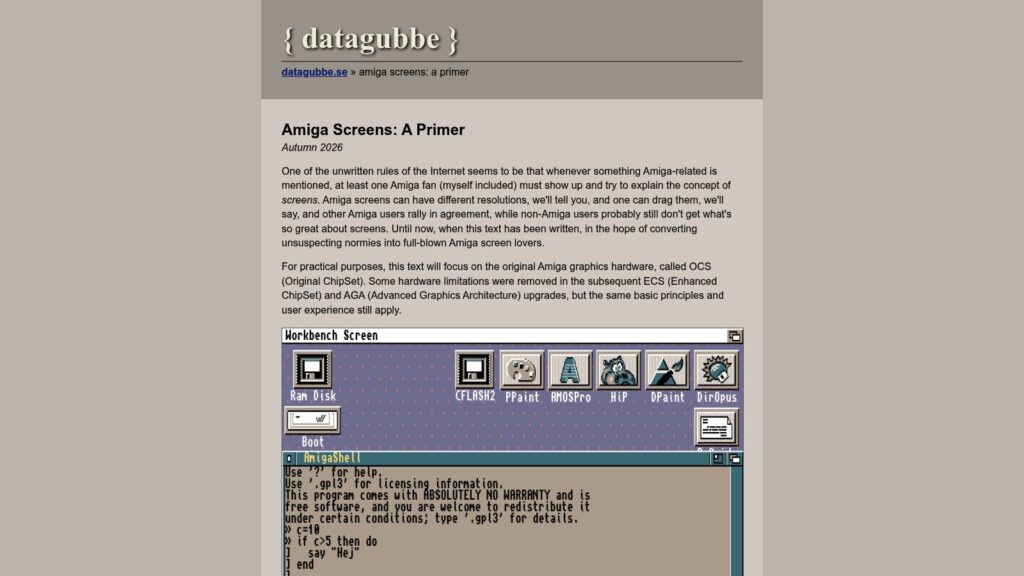
Amiga Graphics Archive

The Amiga Graphics Archive is a dedicated website showcasing the remarkable graphics created with or for the Commodore Amiga, a home computer launched in 1985 known for its advanced graphics capabilities. The site features a rich collection of images, articles, and updates highlighting the art, games, applications, and artists associated with the Amiga platform, preserving the legacy of its unique custom chip technology and its impact on digital art and gaming.

https://amiga.lychesis.net/

Amiga Graphics Archive Read More »

Franklin’s Bad Ads for Apple ][ Clones and the Beloved Impersonator They Relied On

Franklin Computer Corporation built Apple ][ clones in the early 1980s, notably the ACE 100 series, which closely copied Apple’s designs including BIOS code, leading to legal battles. Their marketing featured the beloved Benjamin Franklin impersonator Ralph Archbold, whose image became closely tied to Franklin’s trademark despite the company’s controversial cloning practices. Though Franklin’s products were popular for their affordability and durability, the company eventually shifted away from desktop computers to handheld devices by the late 1980s.

https://buttondown.com/suchbadtechads/archive/franklin-ace-1000/

Franklin’s Bad Ads for Apple ][ Clones and the Beloved Impersonator They Relied On Read More »

Large Scale Systems Museum / Museum of Applied Computer Technology

The Large Scale Systems Museum (LSSM) in New Kensington, PA, celebrates its 10th anniversary in 2025 as a public museum dedicated to the history of computing, focusing on minicomputers, mainframes, and supercomputers from the 1950s onward. As a physical, living museum, it features fully restored and operational computer systems maintained by experienced volunteers for demonstrations, education, and research, highlighting computing’s profound impact on modern life.

https://www.mact.io/start

Large Scale Systems Museum / Museum of Applied Computer Technology Read More »

Original Apollo 11 Code Open-Sourced by NASA — Original Command Module and Lunar Module Code Repos Are Now Public Domain Resources

The article reports that NASA has made the original Apollo 11 guidance computer software publicly available, including separate codebases for the Command Module and Lunar Module. The release allows people to study and run the historic assembly-language programs that helped guide the first Moon landing under extremely limited computing resources. The main point is that opening this code preserves an important part of computing history and highlights the efficiency and engineering required for early space missions.

https://www.tomshardware.com/software/original-apollo-11-code-open-sourced-by-nasa-original-command-module-and-lunar-module-code-repos-are-now-public-domain-resources

Original Apollo 11 Code Open-Sourced by NASA — Original Command Module and Lunar Module Code Repos Are Now Public Domain Resources Read More »

Every GPU That Mattered

The article presents a comprehensive timeline and comparison of 49 significant consumer GPUs launched over 30 years, from 1996 to 2025, highlighting key technical specifications, defining games, and market impacts of each generation. It showcases the evolution of GPU technology from the pioneering 3D accelerators like the 3dfx Voodoo Graphics to modern high-performance models such as NVIDIA’s RTX 5090, revealing trends in transistor count, memory, power consumption, and pricing, while also reflecting on user adoption through Steam Hardware Survey data.

https://sheets.works/data-viz/every-gpu

Every GPU That Mattered Read More »

Scroll to Top